

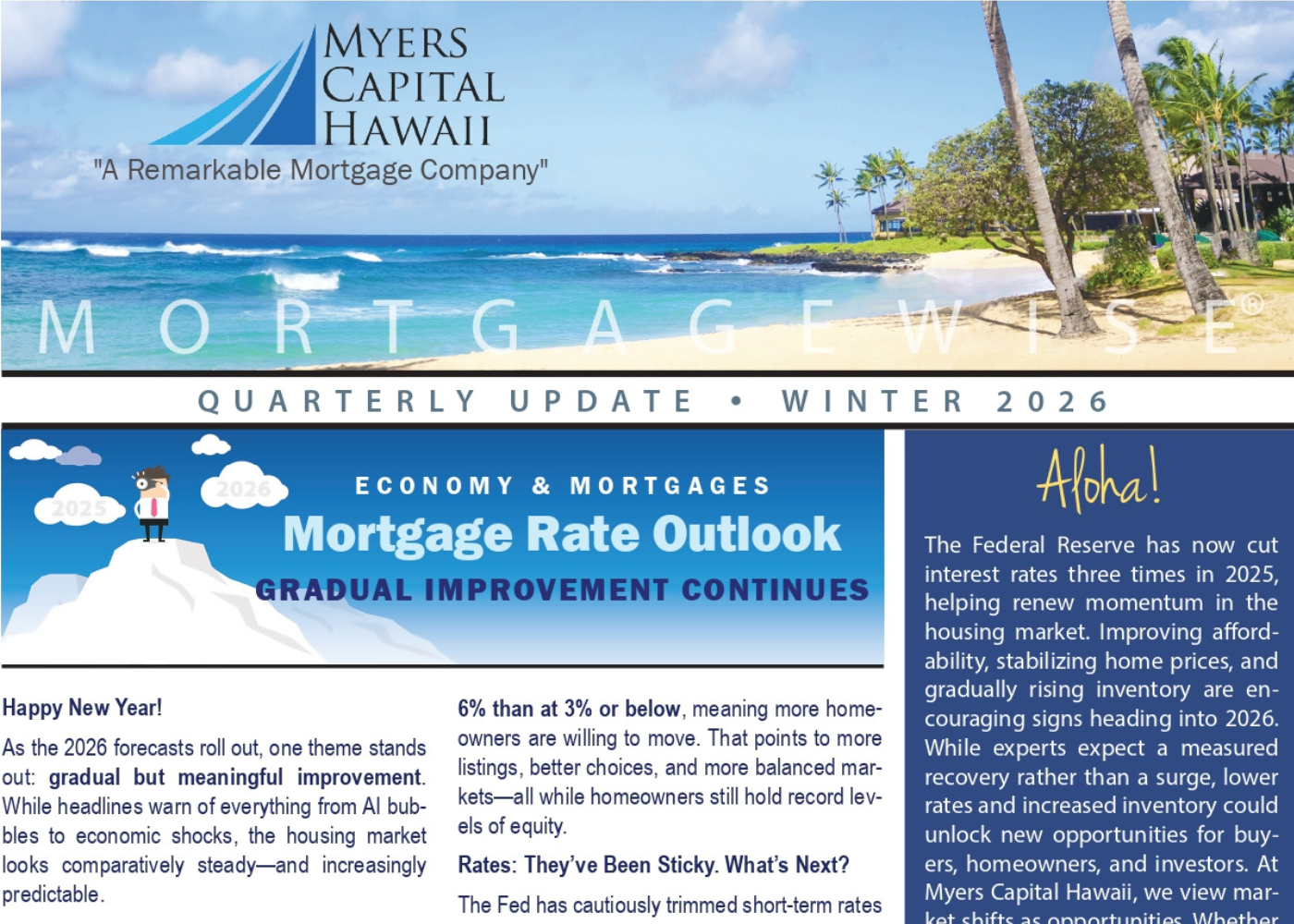
MortgageWise Newsletter Winter 2026
Mortgage News and Updates – Winter 2026
Get the latest mortgage industry news. CLICK HERE.
-Economy & Mortgages: Mortgage Rate Outlook: Gradual Improvement Continues
-2026 Conforming Loan Limits Increased!
-Down Payment Strategy: Finding the Sweet Spot
-Debt-to-Income Ratios: The Quiet Lever That Can Make or Break a Loan Application
-Is the 50-year Mortgage a Good Idea?
Economy & Mortgages: Mortgage Rate Outlook: Gradual Improvement Continues
As the 2026 forecasts roll out, one theme stands out: gradual but meaningful improvement. While headlines warn of everything from AI bubbles to economic shocks, the housing market looks comparatively steady—and increasingly predictable.
Housing: Affordability Slowly Returns (Un-)Affordability has been the housing story of the last few years. Housing costs recently peaked at about 42% of median household income, far above the long-standing 30% rule of thumb. The good news is that pressure is easing.
With home prices forecast to be roughly flat in 2026, affordability has room to recover. The price-to-income ratio peaked above 5.5x income in 2022, has fallen to about 5.3x, and is projected to dip below 5x next year. Truly balanced markets tend to sit closer to 4x income, so there’s still work to do—but the trend is in the right direction, especially if incomes continue to rise.

2026 Conforming Loan Limits Increased!
Adding another arrow in your homebuying quiver, conforming loan limits have once again increased in 2026. Reflecting rising home values and in support of its mission to expand homeownership opportunities, The Federal Housing Finance Agency (FHFA) announced in December that its new conforming loan limits would rise 3.26%, in line with the average increase in home prices in 2025.
The baseline limit rose to $832,750. High-cost markets in urban areas may now have a limit as high as $1,249,125. This is good news for mortgage financing, as these higher limits help homeowners secure better rates and terms, and it improves your buying power! Homes that previously may have required you to take out a jumbo loan may now be acquired more affordably.
And, if you were at the low end of the old Jumbo loan range, it may present an opportunity for you to refinance into a conforming loan with a more attractive rate. Give us a call to discuss!!

Down Payment Strategy: Finding the Sweet Spot
Down payments. A score north of 740 is like VIP access to better rates and thousands saved over the loan’s life. Pay down debt, keep balances low, and hit pause on new credit cards until after closing. Check your score regularly; it's never too early to start taking the right steps.
Why Down Payment Size Matters. Your down payment directly affects the loan terms you may qualify for and how much liquidity you have after closing. It influences your monthly payment, potential mortgage insurance costs, and even loan pricing—specifically how many points you may need to pay to secure a given interest rate.
Look Deeper to Find the Sweet Spots. Loan-level pricing adjustments (LLPAs) are pricing brackets driven by factors such as loan-to-value (LTV), credit score, and other risk elements. In general, pricing improves as LTV drops. Many mortgage programs have clear LTV breakpoints where pricing improves meaningfully, creating true “sweet spots” for down payment strategy.
What to Look For: Sweet Spots Vary by Loan Type. With conventional loans (up to 97% LTV), 20% down (80% LTV) is the biggest inflection point: mortgage insurance disappears and pricing improves. At 25% down, there is often another meaningful improvement in pricing for a relatively small increase in cash, making it one of the best risk-adjusted sweet spots for borrowers who can reach it. For buyers putting 10–20% down, the sweet spot is often around 15%, where mortgage insurance costs commonly drop noticeably.
With FHA loans, pricing is largely flat regardless of down payment, and mortgage insurance is the primary factor. With as little as 3.5% down, borrowers pay both an upfront mortgage insurance premium and monthly insurance. FHA does not reward incremental down payment in pricing; the key sweet spot is 10% down, which causes monthly mortgage insurance to automatically end after 11 years.
VA loans are unique as well. There is no monthly mortgage insurance, and pricing is not closely tied to LTV. Instead, borrowers pay a VA funding fee, which decreases at 5% and 10% down. From a pricing perspective, there is little incentive to put money down beyond reducing the payment and funding fee. For most borrowers, the VA sweet spot is 0% down.
Jumbo loans vary a lot by investor, but typically require at least 20% down, with notable pricing improvements often occurring at 75% and 70% LTV.
Conclusion
Many buyers assume they should put every available dollar into their down payment. In reality, reaching the right down-payment tier can improve pricing just as much—while preserving cash for furnishings, renovations, or savings. Contact me to discuss your next move, and we’ll help you strike the right balance between affordability and liquidity.

Debt-to-Income Ratios: The Quiet Lever That Can Make or Break a Loan Application
Most buyers obsess over credit scores— and that makes sense. But here’s a little-known truth from inside underwriting: improving your debt-to-income ratio (DTI) by just a few points can matter as much as a 20–40 point credit score increase.
Why? Because DTI is the stress test. It’s how underwriters decide whether your income comfortably supports your new mortgage—or whether the loan feels tight, risky, or more expensive. I’ve seen buyers miss approval by a single car payment. I’ve also seen buyers unlock better rates or higher loan amounts by shaving just 2–3 points off their DTI. That’s how loans are actually approved.
Why DTI Cutoffs Matter
DTI compares your monthly debt—credit cards, auto loans, student loans, and more— to your gross income.
Here’s what most consumers don’t realize: DTI works in bands, not on a smooth curve. Moving from 45% to 43% can turn a “refer” into an “approve,” lower mortgage insurance, improve pricing, or increase how much home you qualify for. Often, that shift comes from one targeted change.
Small Moves, Big Impact
Once we calculate your true DTI baseline, opportunities usually appear. Paying a credit card below 30% utilization can lower the payment used in DTI and boost your credit score. Paying off one installment loan can be the difference between qualifying and not qualifying. Even eliminating $75–$100 per month can materially change the outcome.
Beware of “Harmless” New Debt
One of the most common mistakes buyers make is adding new monthly payments before applying. That zero-interest furniture deal or buy-now-pay-later plan? If it shows up as a payment, it hits your DTI. One small obligation can undo weeks of preparation.
Income and Timing Matter Too
DTI isn’t just about debt. Bonuses, overtime, and commissions can often be included with proper documentation, while job changes can affect how income is counted.
Timing matters as well: paying down revolving debt 30–45 days before applying gives credit reports time to update—and keeping balances steady through underwriting is just as important.
A strong DTI doesn’t just help you get approved. It can expand your options, improve pricing, and give you leverage as a buyer—especially when you know which small moves actually move the needle. Let's start a conversation about yours, today!
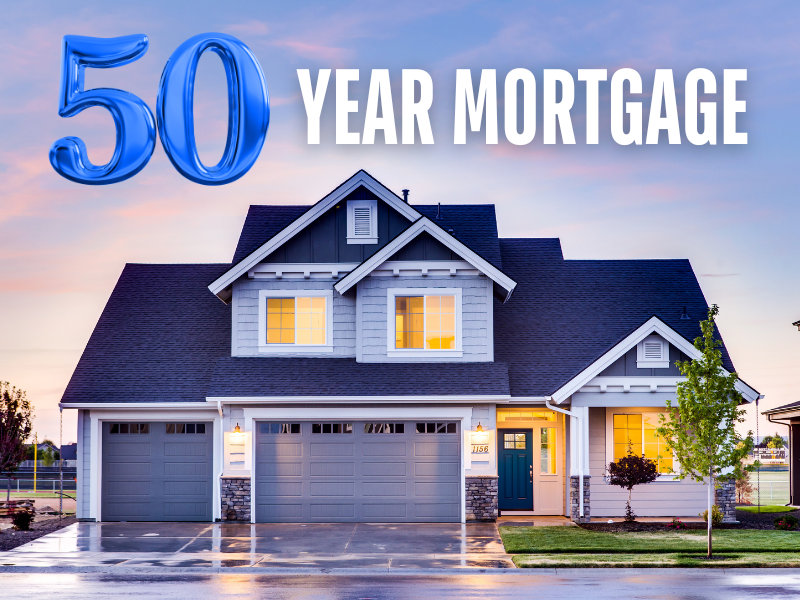
Is the 50 Year Mortgage a Good Idea? (short answer: no)
The 50-year mortgage idea occasionally resurfaces whenever affordability gets bad. The pitch is simple: stretch the loan, lower the payment. But the math—and the market—tell a very different story.
On a $300,000 loan at 6.5%, a 30-year mortgage runs about $1,896/month*. A 50-year mortgage drops that to roughly $1,691—a savings of just $205. That modest relief comes at a steep cost. That 30-year loan costs about $383,000 in total interest. The 50-year loan? Nearly $715,000—almost double the interest cost of the 30-year loan!
Equity is where the damage shows up. After 10 years, the 30-year loan has paid down about $46,000 in principal. The 50-year loan? Just $11,000. Now add reality. On a $375,000 home, typical 6% seller costs are about $22,500. That wipes out the entire $11,000 of equity from the 50-year mortgage—and then some—just to sell.
There’s another reason these loans won’t fly. There isn’t a secondary market for debt with 50-year terms with slow paydown and higher risk. To make them work, investors would likely require a higher interest rate, erasing much of the payment benefit and worsening the already-stratospheric total cost. Similarly, other ideas being floated -- portable or assumable mortgages -- also have structural problems that make them highly unpalatable to investors.
Bottom line: a 50-year mortgage trades long-term wealth for minimal short-term relief—and leaves homeowners exposed when it’s time to sell.
*Example payment for illustrative purposes only. Does not include taxes, insurance, or other costs. Actual rate and terms may differ. Not a commitment to lend.
Copyright © 2026 Myers CapitalVirginia